
Environmental, Social, and Governance
Economic
The key highlights for the economic pillar, including economic performance, tax practices, competition and benchmarking, and the business operating environment, can be found across sections 2 and 5 of the report.
Environment
The environmental pillar covers, highlighting our water conservation, energy efficiency, and waste reduction efforts through recycling and responsible disposal.
Social
Our key efforts focus on strengthening community ties, promoting fair employment, and ensuring workplace safety.
Governance
Key areas focus on leadership structure and our strong governance standards.
Business Conduct and Ethical Standards
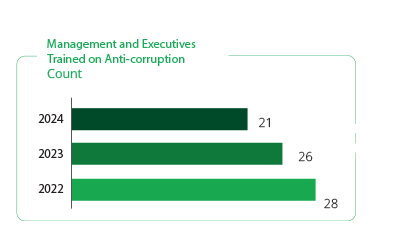
Business Ethics and Compliance
The Group consistently adheres to the various legislative and regulatory frameworks in which it operates and is fully committed to complying with all relevant laws and regulations while fulfilling its responsibilities.
We prioritise honesty, integrity, and fairness in all our business activities, and these values are deeply embedded in our practices. The Group is dedicated to upholding its core business values and ensuring integrity across all operations. We actively work…

Adaptive Strategy
Business Operating Environment
The economic, environmental, political landscape, social dynamics, technological advancements, ecological considerations, and legal regulations all play crucial roles in shaping our business strategies. Zimplow aims to foster business growth, benefit from economic performance, and ultimately increase customer satisfaction. However, impacts stemming from inflation, low sales, and reduced Foreign Direct Investment (FDI).
Zimplow established policies aimed at adapting to market dynamics, regulatory landscapes, and economic conditions. The Group’s commitment to agility ensures that it can adjust to changes in the environment. Zimplow implements strategies to manage and adapt to external factors, ensuring resilience. We avoid strategic drift by conducting regular strategic review sessions and continuously engaging stakeholders in the operating environment. This engagement helps the Group to remain aligned with market demands and stakeholder expectations. We strategically align our operations with the prevailing business environment, ensuring that we capitalise on opportunities for growth and sustainability…
Risk Management
Enterprise Risk Management
Risk management is a fundamental component of our strategy and is essential for achieving our long-term objectives. The success of the Group hinges on our ability to identify and capitalise on opportunities within our business and market environments.
The Board holds ultimate accountability for risk management and evaluating the effectiveness of the business units’ risk management and internal control systems. To facilitate this, the Board established a clear structure with well-defined responsibilities for the major risks in each business unit. The risks are classified as short, medium and long term. For each major risk, we developed a risk management framework that outlines the controls and assigns responsibility for managing the overall risk and the specific controls that mitigate it. Our risk assessment process encompasses both short-term and long-term risks and these risks are subject to continuous review. The risks are formally assessed by senior management and the Board at least annually…

Sustainability
Sustainability Approach
The Group is dedicated to maximising social and environmental impact of its operations while ensuring long-term economic sustainability. Our goal is to drive growth while improving the lives of our local communities and fostering sustainable change.
Stakeholder Relationships
Zimplow embraces a transformational business philosophy, aiming to uncover opportunities to generate sustainable value for all stakeholders and making a meaningful impact as a responsible corporate entity. In our pursuit of enhancing shareholder value, we recognise the importance of various stakeholder groups essential to our success…
Product Quality and Innovation
Tracking our Progress and Targets
Innovation plays a significant role in enhancing our brand reputation, credibility, and trust, offering a competitive advantage by differentiating products from competitors and driving market leadership. However, innovation brings challenges, such as laying off employees due to increased efficiency and longer development times needed to ensure quality. Over-engineering and inefficient processes may arise from an excessive focus on quality, raising costs and complexity. High-quality products involve added costs, from certification fees to regulatory compliance, and may lead to increased resource usage and warranty requirements. Additionally, innovative products can introduce complexity, raising support costs and causing potential financial losses or unpredictable outcomes. Resistance from employees, intellectual property risks, and over-reliance on technology present significant challenges, as does dependence on key personnel and the disruption of established processes…
